Second Announcement
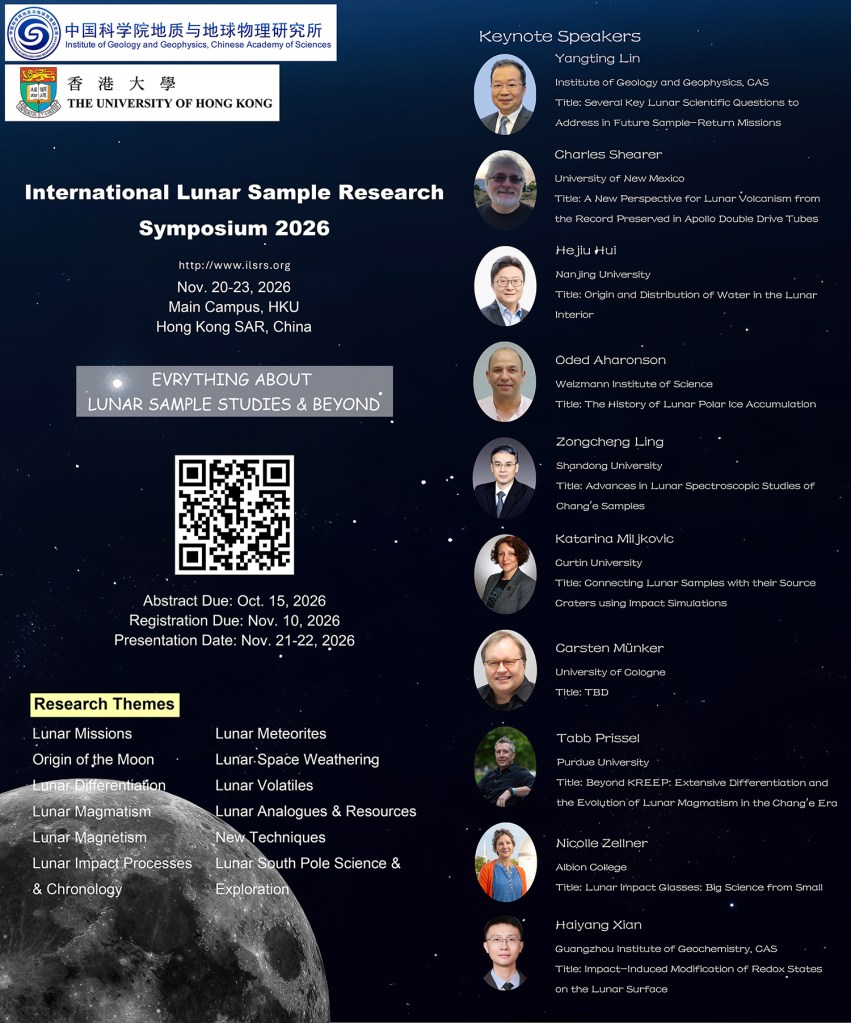
International Lunar Sample Research Symposium 2026
Hong Kong SAR, China
Nov. 20-23, 2026
Website: http://www.ilsrs.org
After decades of lunar exploration, lunar samples have become the largest treasure returned by human beings, with unlimited potential to disclose the secrets of the Earth-Moon system. So far, lunar samples have been collected by the USA’s Apollo-11, 12, 14, 15, 16, 17 missions, the Soviet Union’s Luna 16, 20, 24 missions, and China’s Chang’e-5, 6 missions, and recovered as meteorites. The recent acquisition of the Chang’e-5 samples from the Procellarum KREEP Terrance, the Chang’e-6 samples from the South Pole Aitken basin, and the recent opening of NASA’s Apollo samples in the Apollo Next Generation Sample Analysis program bring a new era of lunar science that is likely to solve the most significant questions that have remained since the Apollo era.
To share the recent findings of Chang’e, Apollo, Luna samples, and lunar meteorites, to prepare for future lunar sample analyses such as those returned by China’s and USA’s human lunar missions, and to foster international cooperation between China and their international partners in all lunar science and exploration disciplines beyond samples, the Institute of Geology and Geophysics, Chinese Academy of Sciences (CAS) and the Department of Earth and Planetary Sciences at the University of Hong Kong (HKU) jointly propose this International Lunar Sample Research Symposium. It aims to present the most intriguing findings from all kinds of lunar sample studies and beyond, including but not limited to:
1) Lunar Missions
2) Origin of the Moon
3) Lunar Differentiation
4) Lunar Magmatism
5) Lunar Magnetism
6) Lunar Impact Processes and Chronology
7) Lunar Meteorites
8) Lunar Space Weathering
9) Lunar Volatiles
10) Lunar Analogues and Resources
11) New Techniques
12) Special Session: Lunar South Pole Science and Exploration
Important Dates
First Announcement: July 1, 2026
Abstract Submission & Registration Open: July 1, 2026
Second Announcement: Sept. 14, 2026
Abstract Submission Close: Oct. 15, 2026
Conference Program Announcement: Nov. 1, 2026
Online Registration Close: Nov. 10, 2026
Conference Presentation: Nov. 21-22, 2026
Arrival: Nov. 20, 2026; Departure: Nov. 23, 2026
Host Organizations
Institute of Geology and Geophysics, Chinese Academy of Sciences
Department of Earth and Planetary Sciences, The University of Hong Kong
Co-Hosts
GIG-CAS & HKU Joint Laboratory of Chemical Geodynamics, Guangzhou Institute of Geochemistry
NWU-HKU Joint Center of Earth and Planetary Sciences, Northwest University
Laboratory for Space Research, The University of Hong Kong
Venue: Yuet Ming Auditorium, Main Campus, The University of Hong Kong, Hong Kong SAR, China
Organizing Committee
Chairs of Organizing Committee: Fuyuan Wu, Guochun Zhao
Scientific Organizing Committee: Nicolas Dauphas, James Head, Clive Neal
Local Organizing Committee: Wei Yang, Yuqi Qian
Invitation Letter: Zhaopeng Chen (chenzp@hku.hk)
Registration
Full registration: 1,500 CNY, Student registration: 1,000 CNY. Registration fee waiver for low and lower-middle income countries and special requests approved by LOC.
Keynote Speakers
Speaker: Yangting Lin (Institute of Geology and Geophysics, CAS)
Title: Several Key Lunar Scientific Questions to Address in Future Sample‑Return Missions
Biography: Dr. Yangting Lin is a professor at the Institute of Geology and Geophysics, Chinese Academy of Sciences (CAS). He earned his bachelor’s degree in Geochemistry from Zhejiang University in 1982. From 1988 to 1990, he conducted his PhD research at the Max-Planck Institute of Nuclear Physics in Heidelberg, Germany, through a joint CAS-MPI collaboration, and received his PhD in Cosmochemistry from the Institute of Geochemistry, CAS, in 1991. His research focuses on the formation and evolution of the solar nebula, lunar geology, and paleoclimate of Mars, primarily through the study of meteorites and deep space exploration missions. Prof. Lin is the Chief Scientist of the Lunar and Planetary Science Expert Group for space science and applications under China’s Manned Space Engineering Office, and the Planetary Scientist for China’s Planetary Exploration Program. He is a Fellow and Councilor of the Meteoritical Society and has served as Vice-President of the Chinese Society of Space Research. He is also an Editor of Geophysical Reviews, Deputy Editor‑in‑Chief of the Chinese Journal of Space Science, and an Associate Editor of Geochimica et Cosmochimica Acta.
Speaker: Charles Shearer (University of New Mexico)
Title: A new perspective for lunar volcanism from the record preserved in Apollo double drive tubes
Biography: Dr. Chip Shearer is a Senior Research Scientist in the Institute of Meteoritics, and a Research Professor in the Department of Earth and Planetary Sciences at the University of New Mexico (UNM). He is currently the lead scientist of the CASA Moon SSERVI node, which focuses on the integration of lunar sample science into geophysical, orbital, and boots-on-the-ground lunar observations to understand the geologic history of the Moon and contribute to its future exploration. He was the initial promoter and later co-lead scientist for the NASA ANGSA Initiative, one of the first steps of the Artemis Program. He was an organizer and editor for Planetary Materials, and New Views of the Moon 1 and 2 initiatives. He is a fellow of the Mineralogical Society of America, a recipient of the Gilbert Award from the Geological Society of America, the LEAG Service Award, and the UNM Exceptional Research and Globally Engaged Research Awards.
Speaker: Hejiu Hui (Nanjing University)
Title: Origin and Distribution of Water in the Lunar Interior
Biography: Prof. Hui is a professor at the School of Earth Sciences and Engineering, Nanjing University. He received his bachelor’s degree from the Department of Earth and Space Sciences at the University of Science and Technology of China in 2001, and his Ph.D. from the University of Michigan in 2008. He joined Nanjing University as a faculty member in 2014 and has been teaching there ever since. He has long been involved in the demonstration of scientific objectives for China’s deep space exploration program and served as a member of the first Lunar Sample Expert Committee. He received the Shen-su Sun Award and the Hou Defeng Young Scientist Award in 2016, and was supported by the National Science Fund for Distinguished Young Scholars in 2021. His research mainly focuses on lunar and planetary geochemical evolution.
Speaker: Oded Aharonson (Weizmann Institute of Science)
Title: The History of Lunar Polar Ice Accumulation
Biography: Prof. Oded Aharonson received his degrees in Applied Physics from Cornell University (1994, 1995), served in the Israeli Air Force, earned a PhD from MIT (2002), and served as a professor at Caltech for 10 years, before joining the Weizmann Institute of Science in 2012. Prof. Aharonson studies planets within and outside our solar system, using theory, simulations, and experiments. He participates in many spacecraft investigations including NASA’s Mars Exploration Rovers, Lunar Reconnaissance Orbiter, and the upcoming European JUICE mission to the Jovian system. He was the Mission Scientist for the Beresheet spacecraft. Prof. Aharonson’s recent papers focus on a range of topics, including lunar ice, characterizing exoplanets using transit measurements, paleoclimate variations on Mars, and planetary magnetism.
Speaker: Zongcheng Ling (Shandong University)
Title: Advances in lunar spectroscopic studies of Chang’e samples
Biography: Prof. Zongcheng Ling is Vice Dean of the School of Space Science and Technology, Shandong University, and Principal Investigator of the university’s Planetary Science Group. He earned his PhD from Shandong University, with joint training at Washington University in St. Louis. After postdoctoral research at the National Astronomical Observatories, CAS, he joined Shandong University at Weihai as a full‑time faculty member in 2011. His research focuses on planetary spectroscopy and remote sensing, lunar and Martian surface processes, meteoritics and deep‑space exploration payloads. Professor Ling has served as a research scientist for China’s lunar exploration programs since the Chang’e‑1 mission in 2008. He identified a new type of mare basalt through integrated compositional and mineralogical analyses using in‑situ datasets obtained by the Yutu rover of Chang’e‑3. Together with his collaborators, he discovered micron‑sized hematite and maghemite crystals generated by large impact events in Chang’e‑6 lunar soils for the first time. He also led the compilation of the world’s first 1:2.5‑million lunar lithologic map and has published more than 200 SCI papers. He was awarded the Hou Defeng Young Scientist Award in 2020, and his research was selected as one of the Top Ten Scientific and Technological Achievements of Shandong Province in 2025.
Speaker: Katarina Miljkovic (Curtin University)
Title: Connecting lunar samples with their source craters using impact simulations
Biography: Prof. Katarina Miljkovic OAM is a multi-award-winning planetary scientist and Professor at Curtin University in Perth, Western Australia, where she also serves as Deputy Head of the School of Earth and Planetary Sciences. She completed a PhD in Planetary Science at The Open University, UK, in 2010. She subsequently held research positions at Imperial College London, the Institut de Physique du Globe de Paris (IPGP), and the Massachusetts Institute of Technology (MIT). She has expertise in numerical and experimental impact processes, planetary geophysics, and the interpretation of spacecraft observations. Professor Miljkovic was a science team member on NASA’s GRAIL mission to the Moon and the InSight mission to Mars. In 2024, she was awarded the Medal of the Order of Australia (OAM) for her service to science as a researcher.
Speaker: Carsten Münker
Title: TBD
Biography: Prof. Carsten Münker is the Director of the Institute of Geology and Mineralogy at the University of Cologne, Germany, Professor of Geochemistry and Cosmochemistry, Head of the Mineralogy and Petrology/Geochemistry Division at the German Research Foundation (DFG), and a Fellow of the International Association of Geochemistry (IAG Fellow). Prof. Carsten Münker’s research primarily focuses on scientific questions concerning the solar nebula, the origin and evolution of terrestrial planets, and the formation of habitable environments. He has led the European Research Council Advanced Grant (ERC Advanced Grant No. 669666) “Infant Earth” and the German Research Foundation Priority Program (DFG-SPP 1833) “Building a Habitable Earth.” He has developed a series of high-precision elemental and isotopic measurement methods, advancing progress in areas such as solar nebula condensation, the composition of terrestrial planet materials, the origin and age of the Moon, early Earth dynamics, and the evolution of early Earth’s ocean environments and extreme environments.
Speaker: Tabb Prissel (Purdue University)
Title: Beyond KREEP: Extensive Differentiation and the Evolution of Lunar Magmatism in the Chang’e Era
Biography: Dr. Tabb C. Prissel is an Assistant Professor of Earth, Atmospheric, and Planetary Sciences at Purdue University. Before joining Purdue, he was a civil servant research scientist and Deputy Lead of Mission-Enabling Science at NASA’s Johnson Space Center. His work at NASA spanned Apollo samples, lunar meteorites, lunar exploration science, and terrestrial field studies of silicic volcanism. At Purdue, his research program integrates sample analyses, experimental petrology, orbital mission data, and geochemical modeling to investigate the evolution of planetary crusts on the Moon, Earth, and other rocky worlds. Dr. Prissel’s research has advanced understanding of primary lunar magmas, the origin of the lunar Mg-suite and its volcanic equivalents, and how geodynamic processes shaped early lunar evolution. He currently serves on the AIRES instrument science team for NASA’s Artemis Lunar Terrain Vehicle and received NASA’s Susan Mahan Niebur Early Career Award for his significant achievements in planetary science.
Speaker: Nicolle Zellner (Albion College)
Title: Lunar Impact Glasses: Big Science from Small Samples
Biography: Dr. Nicolle Zellner is the Herbert and Grace Dow Endowed Professor in the Sciences at Albion College. Her research focuses on the impact history of the Earth-Moon system and the conditions for life on early Earth. She served as a Program Scientist at NASA Headquarters, where she led reviews of national programs and provided expertise on funding research at small schools. Her forthcoming book, Astrobiology and the People Who Study It: Stories of Science and Self, is an edited collection of memoirs. Dr. Zellner earned her PhD from Rensselaer Polytechnic Institute, partially supported by the Amelia Earhart Fellowship. For her work with NASA, Dr. Zellner has received two NASA Group Achievement Awards. She is a Fellow of the American Association for the Advancement of Science; a recipient of the Carl Sagan Medal for Excellence in Public Communication; and the Arthur Anderson Teacher of the Year at Albion College. Over the course of her career, she has taught thousands of students and mentored dozens of student research partners.
Speaker: Haiyang Xian (Guangzhou Institute of Geochemistry, CAS)
Title: Impact-Induced Modification of Redox States on the Lunar Surface
Biography: Dr. Haiyang Xian is a professor at the Guangzhou Institute of Geochemistry, Chinese Academy of Sciences. His research focuses on micro- and nanoscale characterization of extraterrestrial materials and redox processes on planetary surfaces. He successfully developed China’s first nanocrystal structure rapid analyzer based on 3DED technology, which supported the discovery of several new minerals. Using advanced electron microscopy including FIB-TEM, EELS, and 3DED, he revealed the occurrence and formation mechanism of widespread Fe3+ on the lunar surface and the differences in space weathering between the near and far sides of the Moon. He also discovered extra-lunar highly oxidized materials preserved in impact-melted lithic fragments through impact processes. He was awarded the Guangdong Province Outstanding Young Scientist Fund in 2022. He has published over 60 SCI-indexed papers, with more than 30 as first or corresponding author in journals including Nature Astronomy, EPSL, GCA, and National Science Review.
We welcome scientists globally to attend this International Lunar Sample Research Symposium and to celebrate the recent discoveries from lunar samples and beyond!